Pages

Wednesday, October 13, 2010

Milk bags

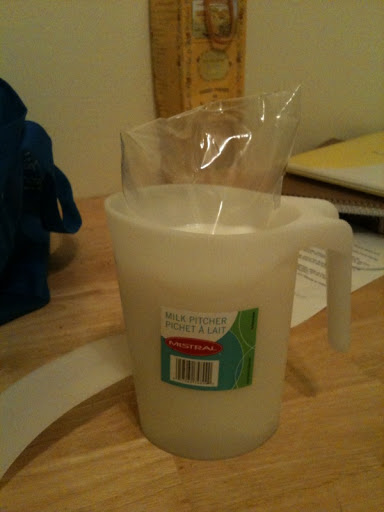
Today I bought milk in a bag. The type of bag that you'd buy rice or nuts in or another solid food item that definitely wasn't a liquid from a cow.

Canada, that's STRANGE. Just so you know.

So strange in fact that for my first year in Ontario I stuck to buying normal cartons. This was also due to the fact that the milk-in-a-bag came in four litre quantities, which seems a bit extreme for me and a cat. I contemplated regularly making white russians for group meeting, rather than buying cookies, but decided it would be a hassle to bring in the glasses every week. So I stuck to cartons until it was revealed to me that inside every four litre bag were in fact three 1-and-a-bit litre bags. Why, it was like matryoshka dolls! So I froze two and dumped the third one in a milk jug with the corner snipped off its tip. Magic. In a bag.

It is, however, still STRANGE. Canada, don't think I've changed my mind about that.

Apparently, the idea of selling milk in a bag was introduced in the UK by the supermarket Waitrose in 2007. Unfortunately it utterly defeated the BBC's technology correspondent and was given up on this April.

That is because people thought it was STRANGE.

Also, we tried to complicate the issue with a clever container rather than telling people to go buy a pair of scissors.

A rival chain, Sainsbury's, is now going to give it another go with an alternative advertising campaign. Rather than focussing on the environmental aspects which went out the window as soon as the bag split, articles surrounding Sainbury's decision always mention one fact:

Canadians like milk bags.

And nobody likes to be outdone by the colonies. Canada itself, however, seems to be suffering from doubt, possibly brought on from the UK outright rejecting milk bags as ...

STRANGE.

The online environmental magazine, the treehugger.com published two articles concerning milk bags. The first came out when the UK were looking askance at the whole idea in 2008 and had the encouraging title "Milk Bags a Hit in Canada, UK". A bold statement that Sainbury's have since picked up on. However, a recent article from this summer was entitled "Is Drinking Milk From Bags Weird?".

Yes. Yes it is. We are pleased you have noticed.

Monday, October 11, 2010

A question of doubt

"I can never trust you again. My entire perception of you has changed."

How exactly do you respond to something like that? I finished my mouthful of food and tried to ascertain what horrific act of wanton cruelty I had committed in the preceding ten minutes. Apart from my lunch containing chicken, there were no obvious possibilities. And if my (apparently erstwhile) friend had a particular affinity to feathered fowl well ... he should have mentioned it before I reached for the second half of the sandwich.

"Have you not moved on from the conversation we were having at the start of lunch?" I guessed.

"No!" He had stopped eating to stare in horror across the table. "I still can't believe it!"

The lunch-table topic had been the question of whether you should be legally obliged to reveal to your partner that you have committed a serious crime, if you met them after you'd been freed from jail. My opinion was no, relationships are private and not a matter in which the government had a right to interfere. If you had served your time in jail and been released, you should have the same rights as any other innocent citizen. My friend's opinion focused on concern that a late revelation of such an act after, for example, marriage and children, would ruin the life of the ex-criminal's partner. He pointed out that there was some precedent for his view in the existence of the sex offenders list, which proved that it was not universally considered that serving your time in jail was always sufficient.

"You might be hiding something from me that would affect me negatively if I found out!" he accused.

"Well, we clearly should have hidden this from you," cheerfully remarked another friend who agreed with me. "Then you wouldn't be accusing us now!"

"You could be right though," someone else commented sinisterly. "Actually they've both served concurrent life sentences."

"True," I agreed. The tomato juice from my sandwich had started to run down my hands. I rose to go and locate a cloth. "They're called postdocs."

Friday, October 1, 2010

Superhero

So last weekend I single handedly defended the physics department from having EVERY SINGLE COMPUTER stolen. And probably all the chalk too. Either that, or I just blew my career right out the water by declaring that an eminent professor was a bounder and a cad. One of the two.

My office mate was leaving. Her thesis was defended and the finished product stacked neatly on her empty desk ready for submission. (It would be later hidden by our advisor in a last-minute psychological experiment ... possibly suggested by me. BUT HE DID IT.) I had come in on Saturday afternoon to help her move her books, papers and two towels (I have no idea) back to her apartment to be packed for her move to California next week. 

As I approached the door to the main building a figure started towards me. He has been loitering on the opposite side of the road, but now he hurried across to stand a mere half step behind me as I fumbled for my keys. When I opened the door, his hand shot out over my shoulder to catch the edge and pull it open.

Boldly, I turned to look the man squarely in the eyes. I admit, he didn't exactly look like your stereotypical robber. Wearing a suit and being significantly over 70 he looked more like ... I dunno .... some distinguished Professor Emeritus.  But I was sure it was just a guise! Beneath that grandfatherly exterior lived a World of Warcraft fanatic, desperate to get his hands on our computing cluster for more power and probably the sword of Azeroth. 

"Could I see some ID?" I inquired, a steely look in my eye.

"Excuse me?" replied gentleman, a.k.a. Horde Undead Rogue

"I can't really let you into the building with seeing some ID, if you don't have your key," I explained, pleasantly. Ha! Where's your sword now, buster?

"I'm a distinguished Professor Emeritus!" the gentleman protested.

Oops.

Okay, I admit, he didn't actually say 'distinguished' but it was totally implied. I prayed he wasn't some famous guy in my field who I had just completely failed to recognise.

It was times like this, I wished I'd focussed on astro-particle cosmology. Then the most famous person in my field would be Stephen Hawking. Dead easy to spot and I could totally have made a get away long before he'd have had the chance to accost me in the doorway of a building.  As it was I stood slightly awkwardly while the Professor Emeritus dug in his wallet for his university ID.

Admittedly, I didn't actually check the name on the card wasn't "Horde Undead Rogue" but it was so totally time to leave. I apologised and scooted off down the corridor at a pace that ensured he would never discover what sub-department I was in.

Friday, September 24, 2010

The power of the pen

The Physics department is going to publish my blog.

Well, not absolutely exactly but near enough for me to be highly entertained. Possibly for weeks.

This rather unlikely scenario was triggered when I saw that the University of Florida had started a department blog. They included news from their research groups, awards and achievements of department members and details of other projects that people were involved in. All in all, it was a great idea and I therefore decided to STEAL IT INSTANTLY AND MAKE IT MY OWN.

So, armed with the Florida blog as a template, an example entry I'd drafted for my own research group and a suggested plan for future posts, I went to see our outreach coordinator.

"I like it," she said, nodding. "But I'm thinking it might be more memorable as a personal perspective on the department. Especially if it were coming from a postdoc, since we don't often hear much from them."

"So ....," I said slowly. "You mean .... like my blog?"

"You keep a blog?"

I emailed her the URL. It transpired to be exactly what she had in mind, although with a focus more on physics and less on stylish footwear for your favourite bovine. I have no idea why.

Walking back upstairs, I joined my research group for our weekly meeting.

"I am going to do a personal blog for the department," I announced as I poured hot water into my tea cup.

"You could write all sorts of things about the faculty!" someone pointed out.

This immediately provoked a discussion that was engaging, entertaining and ended abruptly by me, least my adviser see the folly of the situation and cut the idea dead in the water.

"Oh, I wouldn't do that," he said in a relaxed tone. "I would just read it and if you had written anything unsuitable ... I'd cut your funding."

I stopped with my mug half-way to my mouth.

"You could write good things about the department!" one of my friends cut in with a swift attempt at damage control.

"Yes, that's true," my adviser picked up on the idea. "I could suggest topics I wanted to be covered."

".... and my funding...?" I inquired, delicately.

".... could be negotiated."

Well, it might not be BBC prime time but apparently I have ratings.

Wednesday, September 22, 2010

Flower pot men

"You know how you can tell this isn't original footage? It's not in black and white."

Mmm hmm. That and the scenes the film is showing are battles from China's Warring States Period, around 400 BC. I try to keep an open mind, but there are times when I despair of my fellow museum goers.

As it was, I was having a hard time. My iPhone had been confiscated ... well, no, it was in my bag, but I was forbidden from using it to take notes because the attendant couldn't tell if I was actually taking forbidden photographs. In response to my peeved expression, he provided me with a pen and a couple of sheaves of paper. I thanked him for the effort and spun the appendage around in my fingers, trying to recall how to use it. It didn't seem to have a touch pad. Nevertheless, the hassle had just become worth it to record that quote. (For me and for the attendant, since the alternative might have been to say something; we all know that wouldn't have gone well).

I inched away from the couple in question and perused the information boards. The highlight of this exhibit were 10 statues from the 'Terracotta Army'; the 8,000 life sized warriors that were found in the tomb of the First Emperor of China, Qin Shihuangdi (pronounced approximately 'Chin Shih Hwongdee'). They were found in three pits, the largest measuring 14,000 square meters, which were discovered by a farmer digging a well in 1974. He hit the neck of a terracotta warrior instead of water. In another pit, entire suits of stone armour were buried for the warriors to wear. See, I didn't do badly with my pen. 

At this point in the exhibit, however, the First Emperor was merely a twinkle in some goat herder's eye. Possibly quite literally, since there are debates over his legitimacy. Before his rule, China was a divided land with 7 states warring for power (hence, 'the Era of Warring States' - never let it be said I don't explain events in my blog). Sun Zi's 'The Art of War' dates from this period and observant readers will note it was originally a book, not a Hollywood production. The most aggressive of the states, Qin, had grown rapidly in power due to one of the First Emperor's ancestors, Shang Yang, who embraced foreigners and foreign technologies. American border control could learn much from him. By the First Emperor's father's time, Qin had become so threatening that five states banded together to defeat him in battle. While they won, they never rose again. At the age of 13, Ying Zheng (personal name of Qin Shihuangdi) came to the throne of Qin, kicked everyone's ass and brought China under a single ruler for the first time.

Most of this history is known via a single source, the Shiji document, written by historian Sima Qian. Sima Qian was born 65 years after the First Emperor's death and had no balls; quite literally as he was castrated after irritating his own emperor. Due to the fact he kept the only surviving record of the day, his accuracy can only be verified by archaeological finds. Fortunately, due to a penchant of the times for engraving important events on pots, it is possible to ascertain the truth of much of its content.

Sima Qian did not know about the terracotta warriors whose discovery was a complete surprise. He did describe gardens within the tomb of bronze swans swimming on a sea of mercury, evidence for which has been found during scans and soil samples of the land. The main mound of the First Emperor's tomb remains unexcavated, partly due to concerns for its stability and partly from concerns surrounding the potential damage to the contents when brought into contact with air. The paint on the terracotta army, for instance, was put on natural lacquer which lifts right off if not immediately treated with a superglue compound. Sima Qian did claim a task force of 700,000 labourers was set to build the complex, which started, as was traditional, when the Emperor came to the throne. While this mammoth project was underway, the First Emperor himself searched for the elixir of life and the secret to immortality. I guess there's nothing like a back-up plan.

The purpose of burying 8,000 terracotta soldiers along with you would be for an army in the afterlife. From the Christian standpoint, St Peter was due to be in for quite a surprise. It was undoubtedly an improvement from murdering your actual army and household so they could serve you beyond this mortal coil, and one museum plaque assured me Qin was one of the first houses to abolish this practice. I would have felt more impressed if later boards hadn't revealed that all concubines who had not yet given birth, plus a bunch of the architects, were shut up in the tomb when it was sealed.

The tomb complex, while by far the most famous, was not the First Emperor's only feat during his rule. One of his first ones rather points to an unhappy childhood since it involved returning to his old home of Handen and burying everyone alive. Later acts included the introduction of a single currency and writing script across China and a frenzy of building projects that possibly pointed to mental illness, including large extensions to the Great Wall, roads, canals and dams.

Qin Shihuangdi's plan had been to build a dynasty to last 10,000 generations. In fact, his son flunked it. He kept on and even increased the crushing labour service and taxes of his father, causing a rebellion within four years. The resulting civil war saw the capital burned and parts of the famous tomb looted. When the dust cleared, the Han dynasty started, to be the most famous in China's history. Its principals, however, upheld many of the ones began by Qin Shihuangdi to produce a single, unified, China.
Saturday, September 18, 2010

If the shoe fits ...


... wear it.

I examined the boot in front of me and concluded that it would probably be too loose. That is because it was designed for a cow. My eyes slid down to another piece of footwear with huge pinecone-esque spikes on the sole. Now those would give the right impression during my next presentation!: "Any questions? No, I didn't think so."

I was not in fact at the latest sale from 'Foot Locker' but at a museum dedicated entirely to shoes. Three floors, all packed with footwear, although there was one exhibit on socks which was arguably pushing its luck.

People, dogs, cows and dolls; everyone's pedicural comfort was catered for. Did you know that Polly Pocket's shoe size is a third of that of Barbie's? Or that Ken's shoes are considered (by fashion experts) to be conservative while Barbie's feet are only able to wear high heels?

That particular style has made two débuts in history. The first appearance of high heals in the 16th century saw them being donned by men as well as women to extend their height. Their more recent occurrence was a backlash against claims that the rise of women would see the end of femininity. I looked down at my trainers and wiggled my toes. Screw femininity, you can't do that, Barbie!

Examples of the shoes for bound feet in late 19th century China were also on display. The ideal foot size women of the time was a scant three inches and girl's feet were tied at a young age to prevent proper growth. Feet that remained (through bone breaking deformities) this ideal size were known as 'jin loan' or 'golden lotuses' (right from centre picture). Only girls from the Han ethnic group were privileged enough to forfeit all ability to walk painlessly. Manchu girls were forbidden to bind their feet and therefore wore high platform shoes to stilt their gait and allow them to emulate the 'lotus walk' of their bound footed counterparts (far right photo).

The opposite extreme of the golden lotus shoes had to be the trainer from basketball star, Shaquille O'Neal, who is 7 feet 1 inch tall and wears a size 23 trainer.

Of course, no story of shoes could be complete without mentioning Cinderella. It turns out this originally French fairy tale is told the world over with the glass slipper switched out for culturally favourite footwear. In Korea, a girl named Peach Blossom looses a straw sandal which is found by a handsome magistrate. For some unrecorded reason, he deems this item worth returning to its owner and is promptly enchanted by her beauty and asks for her hand in marriage. One can only conclude the law gives even its enforcers problems.

But whether lawyer, prince, scullery maid or peasant, the magical shoe reveals hidden virtue and transforms an underprivileged beauty into a princess. This says much for the continuing prospects of sketchers but rather less for the hope of humanity. Marrying a girl because she looks swell in a pair of shoes?! It'll be all over even before you get her pregnant and her ankles swell up.

Of course, some shoe transformations have a more practical edge. Alongside the glass slipper was a heavy boot with a large metal ring attached to it. This 'Oregon boot' was for the transport of criminals who couldn't peg it with such a weight on their feet.

Moving upstairs into the side attraction of socks, I discovered the first evidence of such items was a first century letter from a Roman soldier who mentioned a pair being sent to him, probably by his Mum. Much later during World War II, there was such a shortage of nylons that women drew a seam up the back of their legs to imitate their appearance. When the war ended, Macy's sold out of their entire stock of 50,000 pairs in six hours. The production of nylon transpired to be deeply unattractive. And wet. It is produced at the interface between the chemicals diamine and dicarboxylic acid. Drip.

For the ultimate highlight, however, what could beat Geri Halliwell's own Union Jack knee-high boots? Well, possibly the cow boot. But then, aside from the decoration, they were remarkably similar designs.

Tuesday, September 14, 2010

How the other half lives

My face was wet.

It had all been in the name of science. I was walking along the street, admiring the immaculate parks that lay in between the immaculate houses of Aspen town. How did they keep them so green in this baking heat? A large splash mark on the pavement provided a possible answer. It looked like the product of a sprinkler system, except I could not see the sprinkler anywhere. Hmm .... Perhaps it was actually the product of a very large dog.

With that in mind, I gave the puddle a wide birth, stepping onto the lawn. It was then I noticed a peg-sized depression in the ground. Was it a miniature mole? Perhaps like handbag dogs, such downsized creatures had become popular in wealthy Aspen. I bent down to examine it ....

... and was promptly sprayed on the nose as an underground sprinkler popped up and turned its jet right on me.

I sneezed and rubbed my face clear just in time to see the sneaky little watering can disappear into the ground again. Oh the temptation to place a large rock over it! (No, I am not remotely above taking revenge on inanimate objects. We all know that was on purpose.)

Feeling hard done by, I continued on my way. It was obvious physicists were not the main brand of person in this town, or surely there would have been complaints from the regularity of this occurrence.

Of course, there were a few other clues that the Physics Centre was a little out of place here. I stood on a residential street of large detached houses and looked along it. Three mail boxes had been customised to resemble a train, a polar bear and a dog. Little yellow replicate street signs hung outside another four houses, declaring them a Beagle / Maltese / yappy handbag dog x-ing.  The last house in that row was for sale ... by the international auction house, Sothebys. My eyes swept over the deserted windows. Apart from myself, the only people in sight were the gardeners, who had driven in from out of town to keep the flowers in a riot of colour. The property owners were apparently at one of their other multi-million dollar homes; it was not the ski season after all.

Given this obvious display of wealth, it was surprising to see the town had a McDonalds. It is unclear exactly who frequented this. Possibly it was there because every American town must have such an object. Or it could have been there to pacify the black bears, whose regular presence was evident from the extremely complex trash cans. Sadly, I did not get to see a bear during my visit. If I had though, lopping a big mac at it might have seemed like a good option.

I might have altitude sickness but you, you my large pawed friend, now have heart disease, kidney failure and gummed up arteries! Ha!

In anycase, to compensate for this common monstrosity, Aspen felt the need for four large art galleries within view of one another. These exhibition stores sold nothing less that full wall-sized pieces. I attempted to buy a card in one but the concept did not appear to be understood.

Our own apartment had a huge living room with a balcony and a compulsory ski closet outside. I might have been tempted to stay, but the third week in Aspen swept in a cold wind to remind us that the town's actual inhabitants would soon return. I remarked on this sudden change of weather to a friend who replied:

"Well, we've just had labor weekend. It marks the end of summer."

... Huh. Who would have thought the calendar would be so accurate?