Pages

Monday, May 23, 2011

Does whatever a spider cat does

There comes a time in everybody's life when it is desirable to make your cat radioactive.

For many, it is a feeling that a remake of the 'spiderman' movies could be a real hit with one obvious improvement. For others, it stems from a dream to get even with the neighbour's newspaper-chewing dog. For one of my friends, the source was his cat developing an over-active thyroid.

Ramses --known as 'Sir Ramses' by the people who cared for him over Christmas and 'pussy' by his family's newest addition-- had developed hyperthyrodism; a condition caused by tumours (not necessary malignant) on the thyroid gland which leads to an overproduction of hormone. To emphasise his displeasure at this condition, Ramses underlined the inconvenience by having an allergic reaction to every medication designed to treat the problem and ended up in the veterinary hospital. The suggested solution was a dose of radioactive iodine which is absorbed by the thyroid and kills off the excess cells. It only needs to be performed once for a permanent cure. 

There is no mention in the veterinary guidelines of a treated cat morphing into a immensely powerful super villain but, hey, I was optimistic. Especially since said cat was not living in my house. (Though if he appeared at the door, my Tallis could totally take him -- it's what she's been preparing for all these years.)

The 'make your own glow in the dark cat' procedure took place at a hospital 90 minutes drive away. Sick people went in the front, cats were wheeled on a trolley through the back. The nurse who appeared to collect Ramses eyed my car with disapproval.

"When you collect your cat, you shouldn't bring the baby," she informed us, nodding at my smallest passenger who had come along to say goodbye to 'pussy'. "He'll still have quite a high radiation count and that is a very confined space."

Woman, size isn't everything! I covered my car's wing mirrors so it could not hear such comments.

Iodine has a half-life of eight days. Since Ramses ended up staying at the hospital two weeks, he was down to roughly a quarter of his original radiation level by the time we collected him in a baby-free car. Had he been human, there would have been no further guidelines concerning his health. As a cat, however, there was a list of rules that included storing his kitty litter for a further week. Apparently, the radiation levels were still high enough to trigger the alarms at the rubbish dump.

It was after dropping the cat off at the hospital that we all visited the large cats at Killman Zoo. It's good to be prepared.

Thursday, May 19, 2011

Bugs in bugs


"This is a front wheel drive?"

"Mmmhmm."

Chunk. Chunk. Chunk. I watched dispiritedly as the front half of my car was lifted into position behind the tow truck. Resignedly, I noted that this trip was not going to end in a hockey game as originally planned.

I had only driven about ten minutes when the problem started; a juddering from the engine that shook the car. My engine warning light came on and started flashing. I didn't actually know that light could flash but, under the circumstances, I felt a conservative translation would be 'STOP OR YOU WILL DIE'. I bounced into a parking lot and optimistically tried shutting everything down and then turning it back on. Hey, I was a Microsoft Windows user too once. The resulting vibration might have been a seat feature if the car felt remotely safe to drive.

I called the CAA.

I rode with the tow truck across town to the VW garage, resentfully eyeing all the other vehicles around us.

"If we see another yellow beetle, could we just stop and switch them over?" I asked sadly as I spotted a grey bug parked by the curb.

"No problem. I know a guy who'll get you a set of keys for it for $150."

.... all in all, it was probably a good thing we didn't spot car like mine. I wasn't sure what my bill from the garage was going to be, but I was fairly certain it wasn't going to fall below $150.

The price of the repair was a particular concern. In all likelihood, I would be selling the car by the autumn and, at 10 years old, it wasn't going to be worth all that much. An added complication was that I had brought it into the country on a temporary import, so it would be preferable to sell it back in the USA rather than pay tax and duty on it in Canada. That meant that it had to be able to reach the border. I didn't like the idea of pushing.

I sat anxiously at the garage while I debated what my cut-off sum was; the amount at which I run from the room, denying all knowledge of having ever owned a car or evening knowing how to drive. I decided it was somewhere close to $1000. Around the price a serious engine malfunction would probably cost. I knotted my shoe laces tighter.

Miraculously, it turned out to be the ignition coil. Not cheap to fix, but not $1000 either. What was more, the garage had one in stock and fixed it within the hour. I had been hesitant about going to the VW dealership; as a general rule they are more expensive that a generic garage. The fact they were open until 8pm, looked at my car immediately and fixed it on the spot made it all worth while. The only bad news they gave me was that my spark plugs and wires also were showing wear and the oxygen sensor (emissions detector thingo) also needed replacing 'in the next few months'.

I'm pretty confident that'll mean after September.

Sunday, May 15, 2011

Meow


There are several surprising things about Killman Zoo.

Firstly, it is home to one of the largest collections of big cats in Ontario.

Secondly, despite this first point, it has almost no signposting. My GPS unit point blank didn't believe it existed and tried taking us to a school instead; the only location of note it could detect in the rural fields around Hamilton's tiny airport. Google maps did acknowledge the zoo's existence and took us down a rough gravel track where we eventually saw a small square sign directly opposite its entrance. The website for the zoo describes it as "truly one of Ontario's best-kept secrets". Evidently, they're completely serious about that.

Thirdly, several of the cages contained two cats of different species. A female lion and tiger shared a run and a cougar with a lion. Everyone seemed okay with this....

Finally, it has possibly the most unfortunate name for a place containing large carnivorous animals. Since its founder was a man named Murry Killman, the origin of said name is understandable, but I think in such a circumstance I might have changed my name to Willnotkillman.

The animals are housed in cages that look like they've been cobbled together out of salvaged wood. In fact, the whole area has the feel of a animal rescue centre, except for the fact the pens contained GIANT MAN EATING CATS rather than, you know, raccoons. On the other hand, maybe Hamilton is frequently plagued by wild jaguars and the zoo is just very good at rounding them up. It would explain why the local Canadian football team is known as the Tiger-cats.

In addition to lions, tigers, cougars, jaguars and panthers, the zoo is home to a bear, emus, pigs, turkeys and a whole bunch of bunny rabbits. Evidently, there had been some concern for the fate of said fluffy bunnies, since there were large signs all around the zoo stating 'we do not use live prey'. Since there was one pen that was labelled 'African porcupine' but now seemed to consist only of rabbits, this precaution might have been introduced for the reverse reason than most would presume. 

The cages themselves appeared not to be terribly big which left you with the mixed feelings of pleasure at being so close to the animals mingled with concern for their welfare. However, a closer inspection showed that the cages interlinked to give a more respectable sized run, and each cage had a door into one of the large open areas that were alternately occupied by the zoo's inhabitants. Nevertheless, the website indicates that not everyone is satisfied with this solution since it lists warnings to PETA and Zoo Check that Killman Zoo is private property.  To me, the cats looked healthy and one suspects if they were very unhappy, those cages wouldn't hold them for long. Undoubtedly though, any such containment is a hard moral call.

With me on this trip were a couple of friends and their eight-month old son. While we all admired the cats, the baby's all time favourite site was .... a tree. This was likely due to the meanness of his parents in not letting him stroke the large tiger. With one hand on the tree bark, he looked at me and grinned.'

"Mu-mu-muuuummm."

 I raised an eyebrow. I see the logic kiddo, but your generalisation is too great.

Sunday, April 24, 2011

Demon brides


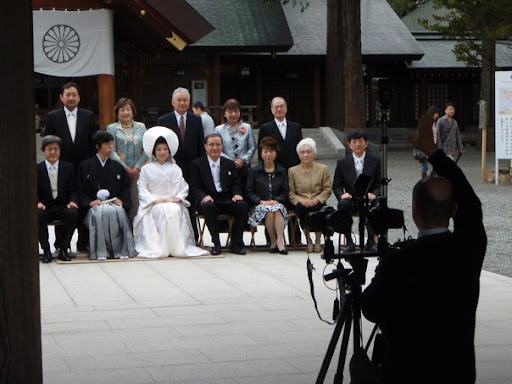
"Is the hat traditional?"

It was amazingly lucky that we had chosen to visit the Hokkaido Jingu Shinto Shrine just as a wedding was taking place. Seated just inside the shrine itself, the bride and groom were being photographed with their close family. I hesitated before taking a picture, not wanting to invade the scene, but since other visitors had no such scruples I tacked on behind them.

One of the major shrines in Sapporo, the Hokkaido Jingu was established on September 1, 1869 by decree of the Meiji Emperor. It is set in a large park which, while not at its most attractive while winter was only reluctantly releasing its grip before spring, was lovely to walk through away from the main city streets. There were several small shrines around the grounds but the wedding was held at the main site.

Like with most western weddings, the bride was dressed in white, but she wore a large semi-circular hat that dropped down over her ears and almost entirely obscured her dark hair. I assumed it was an alternative to a veil, but in fact I was wrong.

"It's to cover her horns." I was told matter of factly.

".... horns?" Was this another part of the traditional wedding dress for Shinto services? If so, I was sorry that the hat had to hide such .... unique .... adornments.

"When they were going out," my friend gestured at the married couple. "Everything was nice between them. But now the woman is a wife, she will become like a demon and will grow horns."

Well, there you have it. There is a refreshingly honest look at marriage in Japan that even the ceremony traditions embrace. 

Saturday, April 23, 2011

Red pill or the blue pill

It was the moment of choice.

I couldn't leave the cubicle without flushing the toilet, yet if I pressed the wrong button I might be surrounded by half the store's emergency staff. Even aside from the embarrassment, I obviously wasn't very well so the risk of being carted off to hospital before I was able to offer any explanation seemed dangerously high.

It occurred to me just then that I still couldn't differentiate the sound for the Japanese for hospital (byouin) from that for hair salon (byoin). Unlikely to be relevant, but it added to the annoyance of the moment.

Looking wildly around for some form of guidance (English directions, alternative flush button, Japanese-English dictionary...) I suddenly spotted a large red button mounted on the wall behind the toilet. This was marked in both English and Japanese with 'Emergency'. So if that was the emergency call button, than neither of the other push buttons could be for that purpose. In which case, surely it didn't matter which I hit ....

I pushed one.

A flushing sound filled the cubicle. It would have been even more wonderful if it had been accompanied by water actually going down the toilet bowl. I looked back down at the row of buttons mounted by the toilet itself. Most toilets in Japan are accompanied by a button for creating a fake flushing sound; they were introduced because the too-modest Japanese woman would flush the toilet needlessly to cover up any bodily sounds, causing a significant waste of water. However, they are usually depicted by a music note and situated along the side of the seat. Indeed, this toilet was no exception. The button was there which is why it hadn't occurred to me that the larger button mounted on the wall would also have this result. Clearly, the department store had felt that one button was simply not enough and what was required was some kind of surround sound experience where both noise options could be engaged. Perhaps customers like to feel that they themselves were being flushed through the plumbing in some strange variation of the 3D movie experience.

Shaking my head slightly, I hit the second button. The toilet cleaned itself. I could go.

Tuesday, April 19, 2011

Return of the toiletator

WHY is it that everytime I have a stomach upset in Japan, the only restrooms I can find have the traditional Japanese hole-in-the-floor style toilets?

The potential for this had seemed amusing as I attempted not to bowl over every department store shopper while making for the restrooms. When actually confronted with three empty cubicles containing floor troughs, the entertainment value dropped by roughly a third for each convenience. The forth and final door in the restroom had a small sign on it marked 'western'. It was occupied.

I swallowed. Did I go with the squat pot and deal with the fact I might be crouched down and unable to move for quite a while? Or did I wait for the western-style toilet to become free with all the discomfort that delay entailed?

I really did need to sit. Casually, I lent against the tiled wall, trying to conceal the fact I was surreptitiously doubling over. At the basins beside me, two Japanese women were washing their hands. I felt a stab of regret I wasn't moving to use the traditional ammenities. No doubt I was confirming every stereotype regarding inflexible foreigners right there. However, there are times to worry about impressions. And there are times to worry about not soiling your clothes. Broadly speaking, they are mutually exclusive.

The door to the occupied cubical swung open. I tried not to nose dive through it. Taking only the moment needed to confirm that no western toilet had this many buttons, I collapsed with relief onto the seat.

Beside me on the wall was a button marked 'push'. Undoubtedly, this was the flush... Unless that was the second button directly above it, also marked 'push'. This upper button had a further description of what said impression would instigate, but it was all in Japanese. The only action I could think of was that one of these choices was an emergency help button, a fact made more likely by the necessity of a disabled customer to use this cubicle. So, if I pressed the correct button, the toilet cleaned itself and I was free to go. Press the wrong button, and the store alarm would sound bringing twenty paramedics into my cubicle.

Was it going to be the red pill .... or the blue pill?

Later, I was to acknowledge there were times when Japan was a bit too exciting.

Saturday, April 16, 2011

Here's looking at you, kid

"You can really eat the whole thing?" It was a question worth asking. One day, I am sure people will lie to me.

A dinner out in Japan is a sociable affair. Rather than each individual selecting his or her own dish, you gather as a group around a table to share sushi, hot pots, savoury pancakes or some other form of fare. Not only is this fun, it also guards against over-indulgence from a desire to finish your entire plate. Of course, this does require everyone to agree on the type of food and it helps not to be a fussy eater. The fact I was not a fussy eater was about to be put to a whole new level of testing.

Uo-isshin (whose name is possibly poorly recalled due to google being in denial) is a seafood restaurant with a specialty in crab. Hairy crab. It was originally described to me as 'furry' but since said fur sticks in your fingers like a fine-combed porcupine, I fail to find that description accurate. Still, since I helped devour its interior and than drank sake from its dessicated carcass, I guess I had my revenge.

The crab was served alongside a large plate of sashimi which included large king prawns with all body parts attached. Rather to my relief, since these were raw, the heads and tails were removed before eating. This complacency was short-lived since a short while later a plate of just prawn heads was produced, cooked and ready to be eaten; eyes, front legs and all. A basic rule I learned was that pretty much anything is edible if you fry it.

"The Japanese do not like waste," I was told by the students who were clearly having far too much fun at my expense. Admittedly, my memories of having to sort garbage in Tokyo into half a dozen different piles made me sympathise with this philosophy. I bit into the head. Crunchy.

The shrimp heads were followed by a grilled flounder. This looked totally delicious and I watched as one of the students carefully lifted the bones away from the white flesh.

"Don't throw out the bone!" The call came from down the table. "I want to eat it!"

I studied the fish skeleton. It consisted of almost nothing beside the delicate array of hair-like bones, held together only by the grilled membrane of skin. People were reaching forward, snapping pieces off and popping them into their mouths. I'm pretty sure this contradicted everything I had been taught about eating fish as a child: remove the bones or else THEY WILL CHOKE YOU AND YOU WILL DIE. Apparently, the secret was just to chew them first.

It was maybe a good thing that this meal was served with sake.

From the flounder we moved onto entire individual fish that were eaten like candy sticks. Roughly the size of a sardine, these fish were pencil-long silver lengths that you chewed your way down. I watched to make sure people really did eat the heads and tails, then bit. They were extremely good once you got over looking your dinner in the eye.

A huge salmon complete with extra roe concluded the meal along with a surprise; two pieces of cold flounder sushi for the gaijin to try (that's me, folks!). They tasted of lemon with a firmer, thicker texture than tuna. There was also a pickle-like vegetable that looks like pineapple triangles and humongous squid served in their shells. We drank sake from the shells too. It seems that it looked big enough to be a threat, it was worth toasting your victory by drinking from its remains. 

As we walked back to the station, I was told that other westerners had not liked to try so much of the seafood.

"You are very brave." I was told.

Why, yes. Yes I am.